
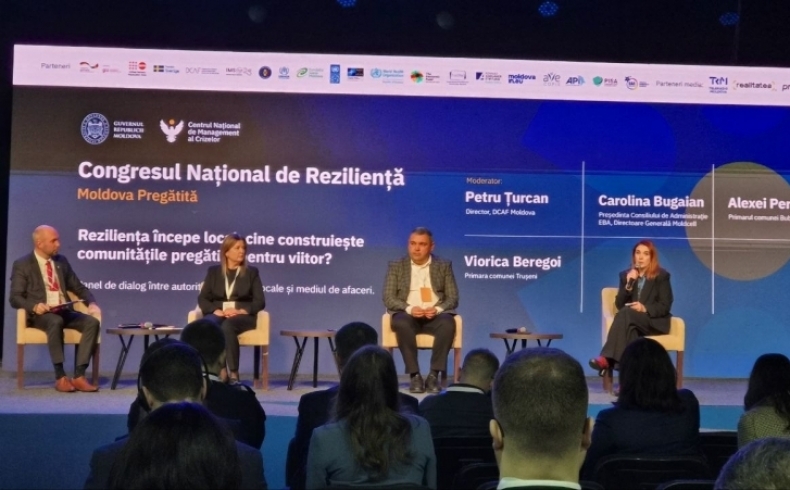
Community resilience starts with effective cooperation between public authorities, the business community and citizens – this was one of the key messages conveyed byCarolina Bugaian, Ph.D, FCCA, CIA, PMP, President of the Board of Directors of the European Business Association (EBA Moldova (European Business Association), during the National Resilience Congress, which also marked the launch of the national programme “Moldova Prepared”.
In her intervention, Carolina Bugaian, Ph.D, FCCA, CIA, PMPhighlighted that preparedness for crisis situations should not be limited to developing response plans, but requires effective coordination, continuous training, communication and practical exercises.
From the business community's perspective, Carolina Bugaian pointed out several challenges that limit the effectiveness of partnerships between the private sector and public authorities: the lack of counterparts with clearly defined mandates, insufficiently defined community needs, differences between the decision-making pace of public institutions and that of companies, as well as insufficient testing of response mechanisms.
She also presented concrete examples of private sector involvement in managing recent crises, including support provided to the healthcare system during the pandemic, assistance offered to refugees from Ukraine, and initiatives aimed at developing the population's digital skills.
EBA Moldova underscores the importance of strengthening dialogue and cooperation between public authorities and the private sector, so that crisis preparedness is built on clearly defined responsibilities, functional coordination mechanisms and practical solutions.
Experience from recent years demonstrates that economic resilience and community resilience are interdependent, while partnerships established in advance are essential for ensuring the continuity of economic activities and essential services.